

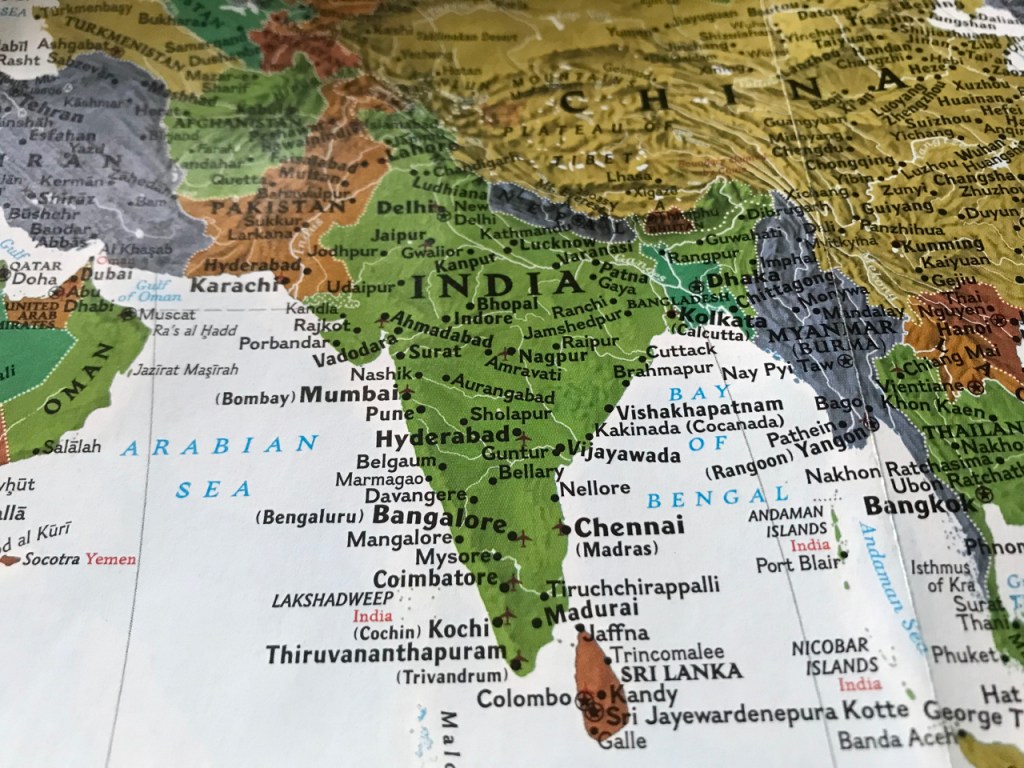
My new interest in tomatoes has taken me to reading about the situation for the crop in India this year. It’s left me embarrassed to think that I’ve been fretting over a few tiny plants here in England, while in India entire crops have been wiped out by either too much rain, or too much heat, or both.
I can’t imagine Indian cuisine without tomatoes but apparently the price of tomatoes in New Delhi is now up by as much as 500% which, while excellent for those farmers whose crops did not fail, must be shocking for shoppers, and almost impossible for the budget end of the restaurant trade.
And it must be difficult for the tomatoes themselves to cope with shifting weather patterns. I never realised that the plants don’t really like the heat, apparently growing best in temperatures between 18C(64F) and 25C(77F). Even English summers now have patches that are hotter than that, as my own plants can testify, having been through their own mild summer hiccup – too much wind, too much heat, and sudden dollops of rain.
If their growing efforts are proving ‘difficult’ here in England, what is the word to describe the conditions faced by plants in India, the country that recently became the most ‘populous’ in the world?
Copyright Georgie Knaggs & The Phraser 2023
 The Phraser
Interesting thoughts Georgie.
FYI, based on 2018 data, China is by far the biggest global emitter of greenhouse gasses, followed by the USA and then India. Chinese emissions are more than double the USA, and growing (fast). Indian emissions are more than half of the USA and also growing fast. USA emission growth is stagnant.
I wonder what effect (if any) the pandemic had on these stats?
I believe it’s too late to stop climate change, the planet has probably “tipped” (based on Malcolm Gladwell’s definition in his old but still relevant Tipping Point essay), and we should be breeding tomatoes that can cope with the heat, rather than wasting time and countless $ on activists whose careers are funded trying to stop an unstoppable, runaway, express (gravy) train.
Cynical, moi?? Now throw those rotten tomatoes at me! 🙂
https://www.unep.org/explore-topics/climate-action/what-we-do/climate-action-note/state-of-climate.html?gclid=CjwKCAjwq4imBhBQEiwA9Nx1BryMO54yCihn0lX9H2E3hFUaRyOZvjpqikyeMfB_FfXHlAg06WWtFxoCBl4QAvD_BwE
LikeLiked by 1 person
Hi – thanks so much for your comment. I did read about the state of emissions round the world and it’s not looking good. I also read about new interest in old tomatoes, and breeding strength into today’s plants. There is a link in the third paragraph (the part of the first line highlighted in blue) about some of the research going on into finding tomatoes that can survive. I hope they find something soon because I think we have two problems – climate, and the political cost of addressing it. Someone was saying best thing any of us can do is make sure we use our votes wisely. I think the second thing, was that the only other real option was looking at what we do our ourselves. Curb what we can that clogs the atmosphere, and where we can, boost our engagement with industries that help to keep the air cleaner. I think the more each of us shows an interest the more the industries see it is worth changing themselves as there are new opportunities. Then, perhaps, the politicians will want to make sure they’re part of it. Meanwhile, of course, there are always those of us who disagree completely.
LikeLike