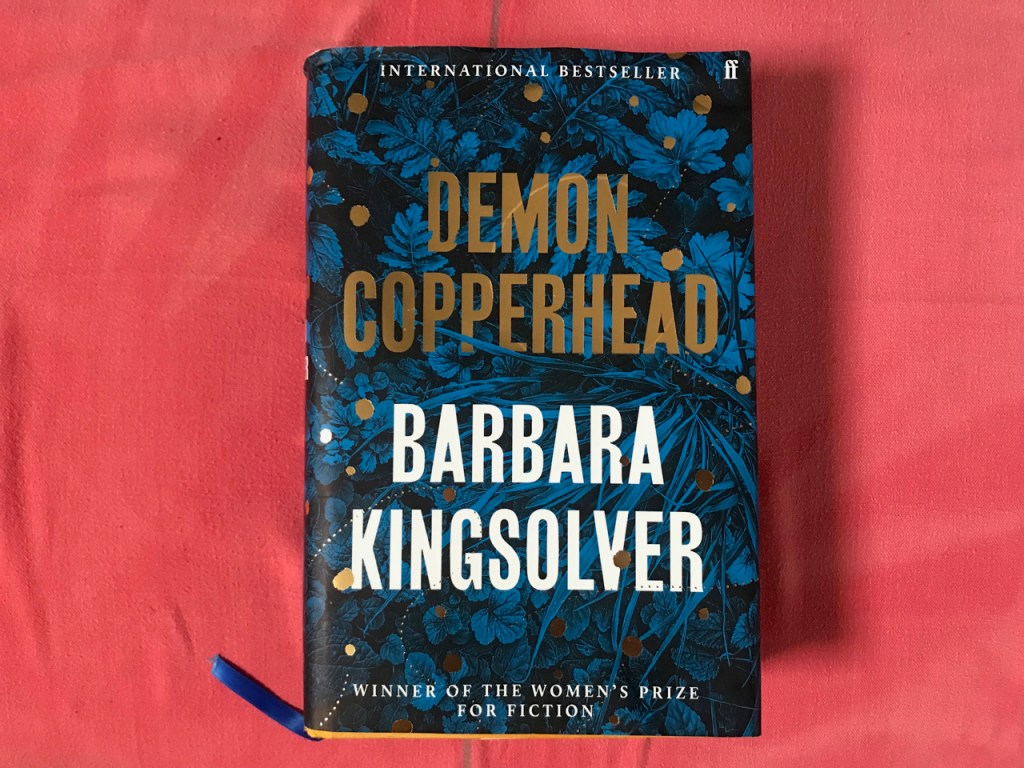
I have had the great good fortune of being lent a hardback copy of this novel. It is a big book – some 550 pages in this edition – and I am a little over halfway through, the reason being that I only manage a few pages a day.
Why so slow? Lack of time is the main reason, plus the distractions drawing me otherwards. However, I treasure the few daily pages I have with Demon Copperhead, and have no desire to leave him to his fate unread. His resiliance and his voice draw me behind him, as he navigates his way into and through worlds I know little about.
Today, I sneaked a few extra pages, and opened the book at the end of the chapter where I had left it. As I turned to the start of the next I read these opening lines:
“Where does the road to ruin start? That’s the point of getting all this down, I’m told. To get the handle on some choice you made. Or was made for you. By the bullies that curdled your heart’s milk and honey, or the ones that went before and curdled theirs.”
Demon Copperhead, by Barbara Kingsolver – opening lines of Chapter 41 – (Faber and Faber)
I’m looking forward to finding out the remainder of the story. I fear it may not end well for Demon Copperhead.
Yesterday, while Zimbabwe struggled into the murky, crocodile infested waters of vote counting, we were invited to an outdoor production of Shakespeare’s Twelfth Night.
I studied Shakespeare while at school in Zimbabwe, but his works made as much sense to me then as the European history the teachers coaxed us through. I managed to memorise enough of both subjects to pass exams, but as far as I was concerned, they may as well have come from Illyria itself. By the way, in case you’re as under-informed as I was until a few minutes ago, Illyria did exist in classical times, somewhere around Albania I think.
Anyway, back to the romantic comedy, Twelfth Night, which is set in a fictional Illyria. The production we saw was by an outdoor theatre group, also called Illyria, and the cast of five were brilliant. Their set was tiny, and their costume and character changes as swift and smooth as butter melting. It was such a funny, engrossing production, despite the night turning from hot summer, to bone cold by the end.
As we carried our picnic back to the car I wondered about the news from Zimbabwe. How were things going? This evening, as I do a little light research into Shakespeare, I am still wondering. I’ve moved on to his quotations now, and I think I’ll end with these:
“It’s not enough to speak, but to speak true” (A Midsummer Night’s Dream – Act 5 Scene 1)
“Love all, trust a few, do wrong to none” (All’s Well That Ends Well – Act 1 Scene 2)
“Hello. Is a lady called Simidele there?” The voice of an older man cuts down the line.
“Fred?”
“Simidele?”
“Yes. Marybelle called to tell me that you’re both coming over to see your daughter.”
“Correct.”
The strength in Fred’s voice amazes Simi. He does not sound like the old man with the wavering cough, who she last saw wrapped in blankets on the lodge verandah. “You sound well.”
“I am well. We’re going to stay with my daughter in Rotherhithe. May we see you while we’re in London?”
“Of course. When?”
“Two weeks time.”
“I shall be in my shop, working on our new project.”
“Ah. A new project?”
“To raise funds for that school – the one near the lodge that got hit by the landslide.”
“Ah …” says Fred.
Simi hears hesitation, and pauses her enthusiasm. “It’s a good idea isn’t it?”
“Well … it’s a generous idea,” Fred replies.
“But?”
“But, perhaps we need to fund our own schools.”
“Yes, but surely after the cyclone …. don’t you think you need some help?”
“Of course, but we must be the helpers. Zimbabwe is rich, and we know how to build schools.”
Simi frowns. “But …I thought … I mean … things didn’t look great even before that cyclone. Now there’s all the damage?”
“I agree, but if everyone keeps fixing us, our leaders will keep robbing us. That’s the problem. Anyway, what if we came over there and started building schools?”
Simi laughs. “Are you serious?”
“Yes,” says Fred.
“But … you wouldn’t have to. We’ve got plenty. I think we can manage.”
“There you go. That’s where we need to get to.”
Simi feels her excitement flattening. “So what then? What can I do? How can I help?”
“Help one of your own schools, while thinking of us.”
“Really?”
“Yes. And, you could always give us lunch?” Simi hears the smile in Fred’s voice. “Shall we say the last Wednesday of the month? Leave plenty of time to fix the world.”
“It’s a deal,” says Simi, unable to keep the excitement out of her voice, despite the squashed plans.
“Not sure what time we’ll arrive. I’ll telephone when we get there.”
“Perfect. And you’ll meet my assistant and new designer, Lola. Kaftan Shop. You’ll find it on the internet.”
“I look forward to it. Best greetings to you both. Goodbye.”
Simi puts the mobile back in her pocket. She looks at Lola and sees that she is struggling not to laugh.
“What’s so funny?”
Lola’s reply tumbles out, each word grinning. “You. He was the soldier, right?”
“Yes.”
“Well … I could sort of hear him. Made you listen.”
“And?”
“Sounded like he didn’t want our help.”
“Well, I don’t know if he knows ….”
“Makes sense to me. He’s not going to want your charity.”
Simi feels a flash of impatience. “You didn’t see what a mess it all was out there.”
“No. But I know my old school needs help. Our library books were so ancient …”
“Huh.” With a swirl of kaftan Simi turns away from Lola’s mirth, and stands looking out through the front entrance, arms folded. She sees that it’s raining outside, and that Joe and his dog are now huddled together under the same plastic mac.
“What are you going to do with Marybelle and the soldier when they’re in London?” Lola asks.
“I have no idea,” Simi replies, quietly.
Marybelle in London – that’s going to be a whole other story.


 The Phraser