Unknown's avatar

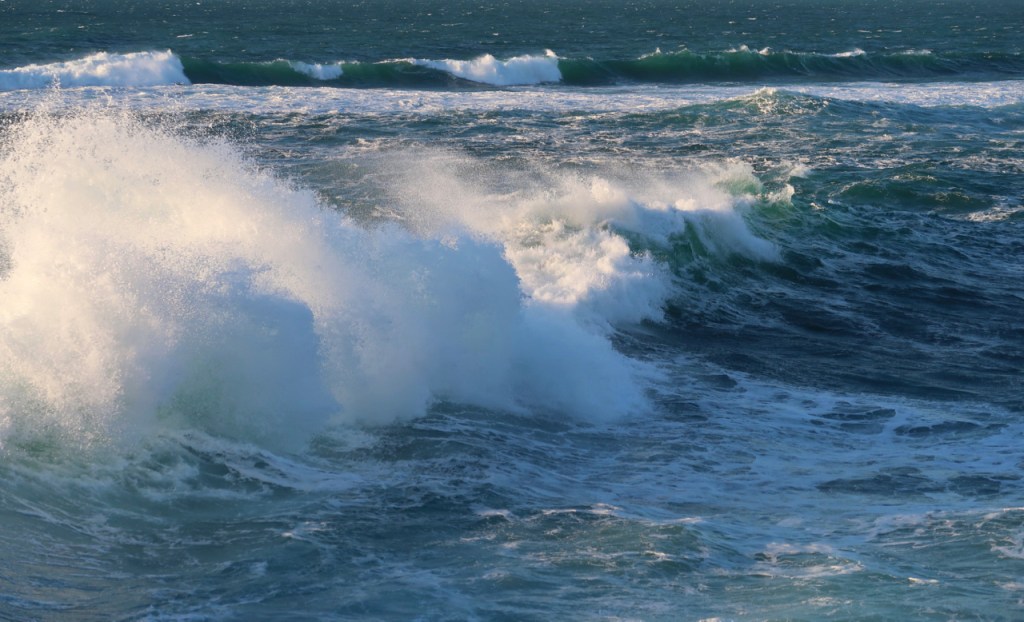
The ocean looks so peaceful until it’s not

Right now I am thinking of all those trying to sort out the damage left in the wake of Idalia. The name is so pretty, but the destruction she’s leaving behind her is not.

Here are three things I never knew, but have picked from the various reports on the hurricane. The first is the exact location of the ‘Big Bend’. It’s an undeveloped natural area, in the wide indent near the top edge of the west coast of Florida. Maps will explain it better than me, but the main point is that it’s not usually where hurricanes make landfall.

The second piece of information is that the reason some of the most dangerous hurricanes begin with the letter ‘I’ is that by the mid-point of hurricane season – June to November – the storms are usually at their most deadly, and the naming tends to have reached the middle of the alphabet.

The final piece of new knowledge for me, is that storm surges can often cause more destruction than high wind strengths due to the weight and volume of water. In Idalia’s case the situation could be made worse by the large tidal range in the area combined with the gravitational pull of this week’s super moon.

It looks a hazardous combination. I just hope that Idalia will prove gentler than expected. Thinking of everyone.

Copyright Georgie Knaggs & The Phraser 2023
Unknown's avatar

Artificial intelligence – feels like it’s closing in

I’ve just sat in on a fascinating talk hosted by the Writers’ Guild of Great Britain (WGGB) looking at how writers might get along in future with ChatGPT and all its cousins. Not sure there were any answers, but it made me think.

These are a rough outline of the main points that I took away from the talk:

  1. Many of the artificial intelligence tools are being created in America.
  2. The capability of these tools (whether intelligent or not) is improving rapidly.
  3. They mine open source data voraciously, without being particularly mindful of copyright.
  4. Their appeal to ‘bottom line’ enthusiasts is enormous.
  5. They require considerable resources to run, both human and environmental, which jeopardises both their ‘ethical’ and their ‘sustainability’ credentials.

How should the creative industries respond? We all pondered this, not quite sure about the answer, but cheered by news that apparently an American court had ruled that content created solely by artificial intelligence could not be copyrighted. This should link to a piece in The Guardian giving more context to this ruling.

So how then to value the work created by humans? Perhaps one way forward might be for individual writers to apply for something equivalent to a trademark to provide assurance that work carrying the mark has been created by an idientifiable individual, and that no ChatGPT or its like have been used. Use of such tools would disqualify use of trademarks. In other words we would be certifying ourselves and our work as ‘organically human’ (and, ideally, sustainable, ethical, and perhaps listed as originating from a particular region).

I may be a bit late with this idea but I thought I’d put it out there.

Copyright Georgie Knaggs & The Phraser 2023
Unknown's avatar

While things are up in the air …

While Zimbabwe votes, two ‘up in the air’ events have been on the news here.

The first happened in Pakistan, where some teenage school children and two of their teachers, were trapped in a cable car high above a gorge for fourteen hours. The footage made the situation look so precarious and perilous, the car swinging from just one cable, as first a military helicopter attempted a rescue, and then rescuers on a zipwire. The helicopter managed to extract one child, but the wind conditions and the effect of the rotor blades on the dangling car, were too dangerous for the helicopter mission to be repeated. Thankfully those on the zipwire managed to save the rest.

Meanwhile, neighbouring India has just celebrated the world’s first successful soft landing near the south pole of the moon. This too is being widely celebrated, except perhaps by those who hoped to get there first. Russia’s rocket, attempting to do the same thing, crashed landed a few days earlier.

To me these two events show so much about the extremes of life, and us as a species. The cable car rescue, set against the backdrop of rural necessity, showcased deep humanity and courage, while the landing on the shadowy side of the moon was all about the precise execution of soaring ambition.

Somewhere in between the two are most of the rest of us, holding on tight.

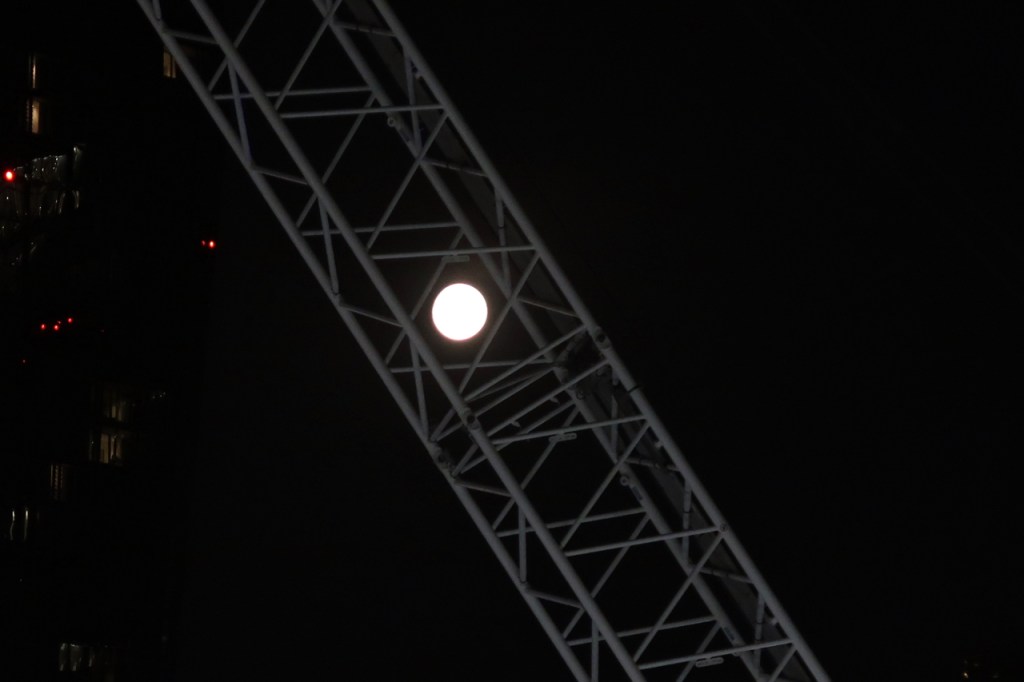
(The photograph at the top of this is of a full moon in London, and, if I remember correctly, I caught it shining through the bars of a crane).

Copyright Georgie Knaggs & The Phraser 2023