Unknown's avatar

Last Stop on Market Street

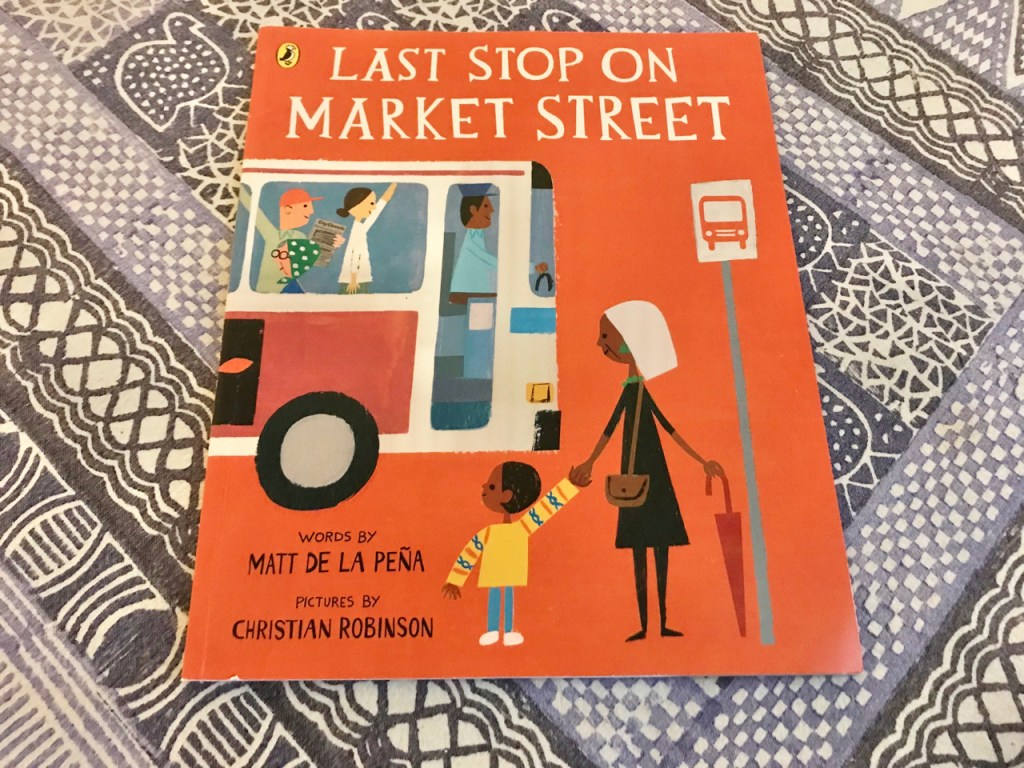
Here is another picture book that I’ve enjoyed. I only discovered this one today when it was picked out of a pile by a young girl I was reading with.

The story is simple. It is about a child’s route home with his grandmother after school. He wishes he could drive away in a car like his friend Colby, but his grandmother insists the bus will be fine. And it is. On the journey he meets the people from his community, and sees how his grandmother interacts with them, gently showing him how much he can learn and enjoy from their company. Their bus journey ends at the last stop on Market Street, which is in a raggedy neighbourhood. The boy is a little unnerved as they make they way through it to the soup kitchen, where his grandmother is soon serving the others.

It is a quiet book with strong themes that don’t dominate the story too much. Instead they are woven cleverly into the words or picked up by the pictures in such a way that they let the journey take us to the end of the book. I thought it was such a powerful combination. The text is by Matt de la Peña, and the pictures by Christian Robinson.

When the young girl and I reached the end of the book I flipped to the back cover and saw that it had a small picture at the top with the words “Gold Medal Selection – Dolly Parton’s Imagination Library”. I was so excited to read this, as I’d heard often about the free books delivered to children from Dolly Parton, and here in my hands, was one of them.

These are some of the words on that back cover, describing her hopes for the books:

“… Dolly understands that reading is the key to a strong education, and that a child’s imagination is the centre of his/her dreams and creativity. By combining the two, this programme inspires children to dream more, learn more, care more, and be more …”

I thought this book did all of that.

Copyright Georgie Knaggs & The Phraser 2023
Unknown's avatar

Something to cheer the day – Oi Frog!

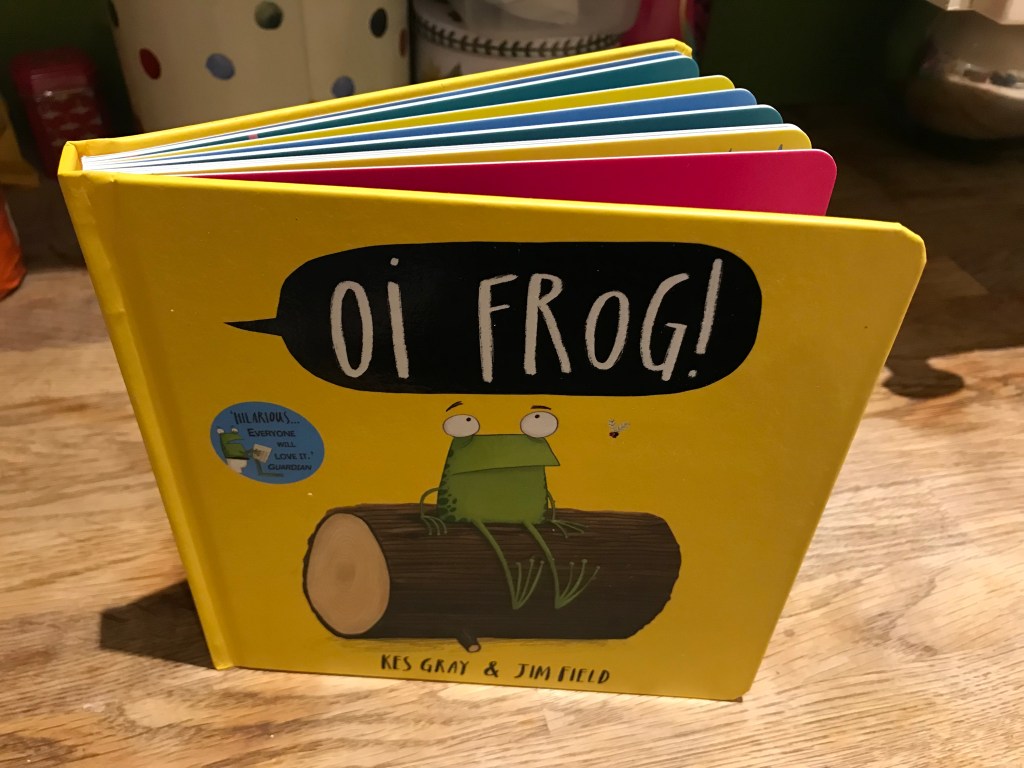
Such a smile of a book! I picked it off a shelf on a cold grey day in one of London’s bookstores.

It was early evening. A mother and her two children had come into the shop behind me. The little girl was intent on a finding a particular book to read, while her brother, not much younger, was only interested in the sticker books. Unluckily for him, his mother was not prepared to buy them unless he read them. As I wandered around the shelves the situation between mother and son deteriorated. Watching them exit empty-handed I wondered if Oi Frog! might have bridged the divide.

In the book Frog is looking for somewhere to sit, but a bossy cat is monitoring Frog’s seating choices, making sure that he is directed to the appropriate place. Frog however, does not see why there should be any restrictions on where he sits, and begins to ask a string of questions. Cat, frustrated by Frog’s lack of obedience, then goes through a list, pointing out which animals should sit where. It soon becomes clear that the seats are allocated according to rhyme rather than reason or comfort, the illustrations getting more and more joyfully ridiculous. But still the ever-challenging Frog keeps up with his questions, interrupting the list occasionally to ask about a particular animal, and where that might sit. In the end it is his final question that brings the book to a close, the last page of illustration saying everything that Frog cannot.

I flipped through the book several times in the store. My first scan was quick, and so was the second, and then when I got it home I started to look more slowly, smiling at every page. The idea seems simple, and the rhymes seem obvious, but combined with the illustrations and the ending, this little book is to me a work of art. I hope it will be one that holds its place happily in any pile or shelf of children’s picture books for many years to come.

Copyright Georgie Knaggs & The Phraser 2023
Unknown's avatar

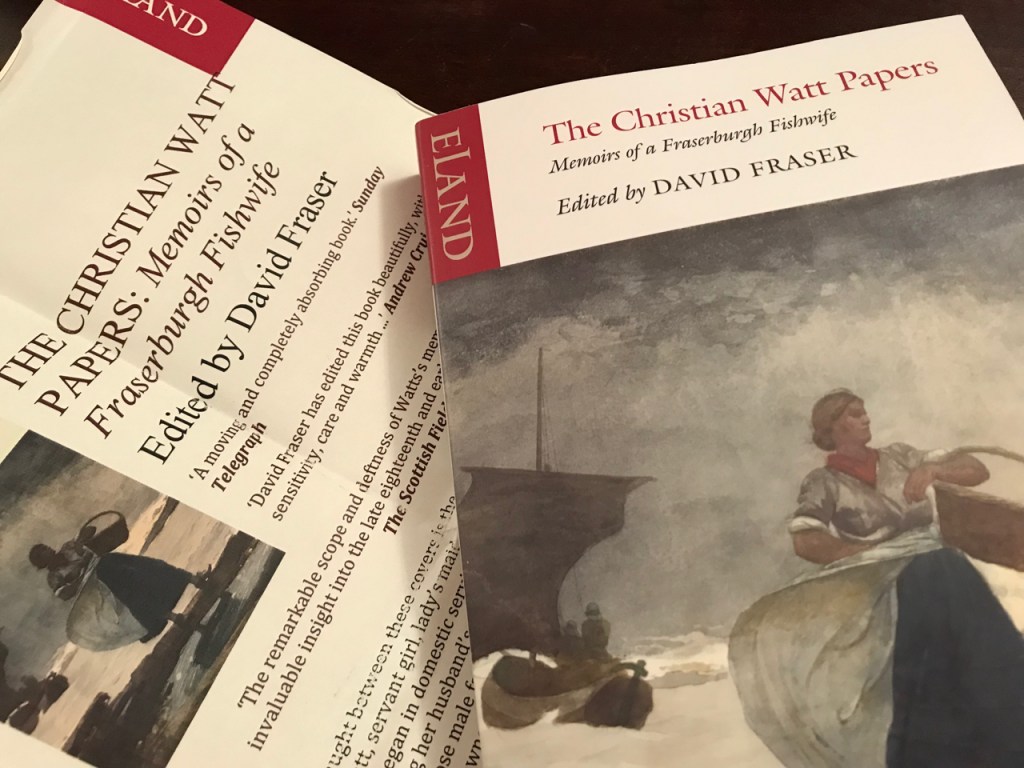
The Christian Watt Papers edited by David Fraser

Another treat of a book to travel with, and it feels right to be taking it to Inverness and the Moray Firth.

Eland included a short press release with this copy, and it emphasises that the ‘voice’ in the book is that of Christian Watt. She was born in 1833, and it is her words used, as found in the papers and notes she left when she died in 1923. Apparently she was encouraged to write as a type of therapy to help her through the loss at sea of a son, her husband, and four of her seven brothers. The family kept all her work together and after her death passed them on to David Fraser, who organised and edited the collection ready for publication. The first copy was published in 1988, with this edition coming out this year.

I have only just started the book but already the voice and its context are drawing me in. The hardships endured sound terrible. Christian Watt was not even nine when she began work as a domestic servant. She then returned to work back by the sea where her family where from, and eventually married a fisherman.

The introduction to the book ends with these words: “The times through which she lived were hard, and the folk they produced were not only hard but brave and tender. It is fortunate indeed that they come to meet us through the words of so worthy, witty and fluent a chronicler.”

Copyright Georgie Knaggs & The Phraser 2023