Unknown's avatar

A visit to the Chris Killip Retrospective at the Photographers’ Gallery, London

‘Brian Magor, baby Joanne Ewens, Tanya David and unidentified youth, 1982’ (photographed by Chris Killip)

I saw this exhibition thanks to an invitation from a friend. It is the most moving collection of photographs I have ever seen.

Prior to the invitation I had never heard of Chris Killip or the Photographers’ Gallery. Both were such a surprise, and so worth the trip.

Chris Killip, born in 1946 on the Isle of Man, has taken the most moving, intimate photographs of corners of society cut adrift by the pace of change. The Photographers’ Gallery has put together a retrospective, showing pictures from the different locations. Many of the images in this exhibition have been taken on the Isle of Man, in Tyneside, and on the Northumbrian coast, capturing families and individuals living lives they knew, while the world changed around them. I found each shot deeply respectful and revealing. I absolutely loved it.

From the mid-1990s, until 2017, Chris Killip was a professor emeritus in the department of visual and environmental studies at Harvard. He died in the United States in 2020.

If you get the chance to visit, the exhibition is on at the Photographers’ Gallery, until Sunday 19 February 2023.

This link is to an interview with Chris Killip. In places it is quite hard to hear, but it does have an excellent story at its heart.

Copyright Georgie Knaggs & The Phraser 2023

Unknown's avatar

About another book – ‘Glory’

Here is another book, one I read last year when it was on the short list for the Booker Prize. I’ve never read another book like it.

The author uses language differently. The novel seems to crescendo and ebb around the animals at its centre, often repeating whole phrases and sections to make a point. I kept having to pause and re-read, but I don’t think that’s a bad thing.

Much like Animal Farm, the story is about the damage and awe that surround egocentric, brutal power. There are headings and situations that swing me from laughter to frustration, and back again. Then, in the middle section of the book, the tempo suddenly changes. Here the story aims straight. Simiso Khumalo tells her daughter about their family, and how it was suddenly ambushed by horror. The words are simple and the scenes shocking. I could barely breathe as I read this part for the first time, and its intensity lingered as the injustices multiplied towards the end of the book.

For me this is a storyteller’s story. Trapped on the page Glory almost feels too alive, too big, as though it needs to burst out on to the stage. I hope it will find itself there one day, because I don’t think it’s an average novel, nor is it any old tale. It’s a challenge to all of us – a reminder – and so worth reading.

Here’s a quotation from the novel:

“If I don’t write, then who will I blame when I wake up one day to find myself in the belly of a crocodile that calls itself History, that devours the stories of everyone else and goes on to speak for us?”

Grandfather in ‘Glory’ by NoViolet Bulawayo

ISBN: 978-1-784-74429-8

Copyright Georgie Knaggs & The Phraser 2023
Unknown's avatar

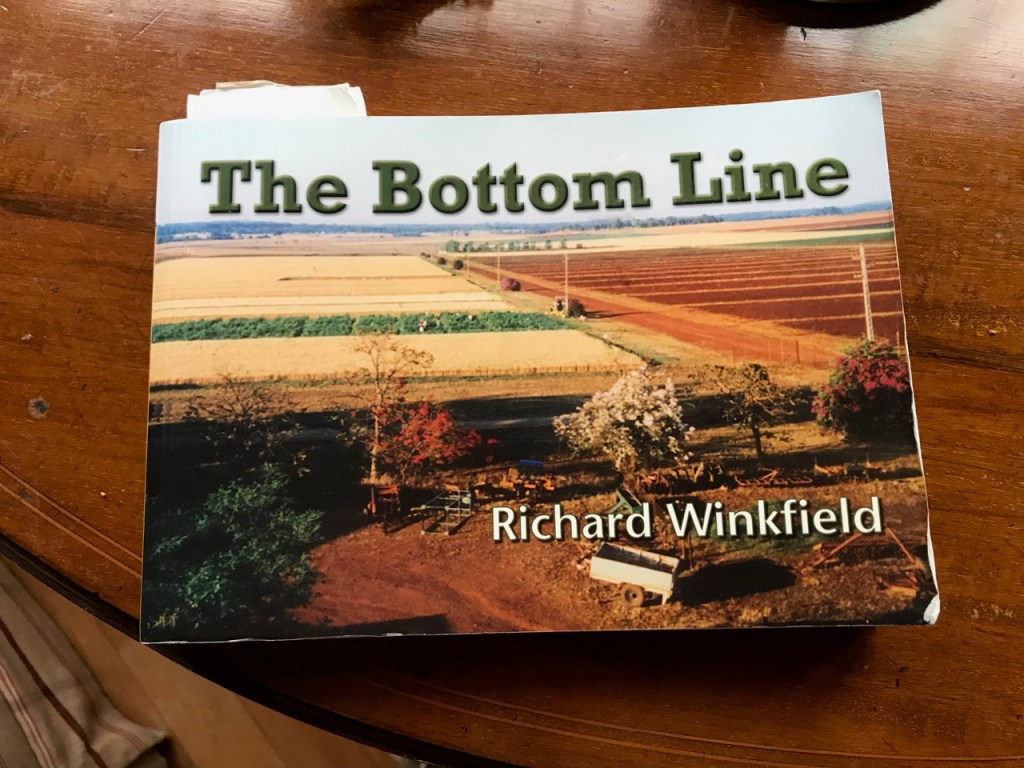
About a book – ‘The Bottom Line’

The first book I finished this year was The Bottom Line. It was the cover that attracted me, the red soils and farmland taking me back to my childhood, spent on a farm not far from where Richard Winkfield was writing.

The book is made up of short articles, written by the author some three decades ago, for The Farmer magazine in Zimbabwe. As well as being a columnist, Richard Winkfield used to run the Agricultural Research Trust (ART) farm, outside Harare. He was the director there from 1985 – 2000, the years covered by this collection of articles, years that began with such hope for Zimbabwe’s farmers.

I know about that time, but for much of it I was outside the country. I missed the day to day, and was not present during the destructive years that ripped the farms and the farming communities apart. Reading The Bottom Line took me back there.

The stories and advice are aimed at fellow farmers. Minimum tillage is a big theme, alongisde personnel issues, and glimpses of what’s going on in the rest of the world. The book is full of resilience and hope, and refuses to let go of that hope, despite the anguish it refers to at the end.

I found the read both easy and unsettling – a bit like watching a storm develop off a shore that cannot see what is about to hit it.

If you’re interested in Zimbabwe’s farming story I hope you’ll be able to find a copy of the book. I only wish I had bought more than one. In case it might be of use here is the ISBN: 978-0-7974-4688-5.

Copyright Georgie Knaggs & The Phraser 2023