Unknown's avatar

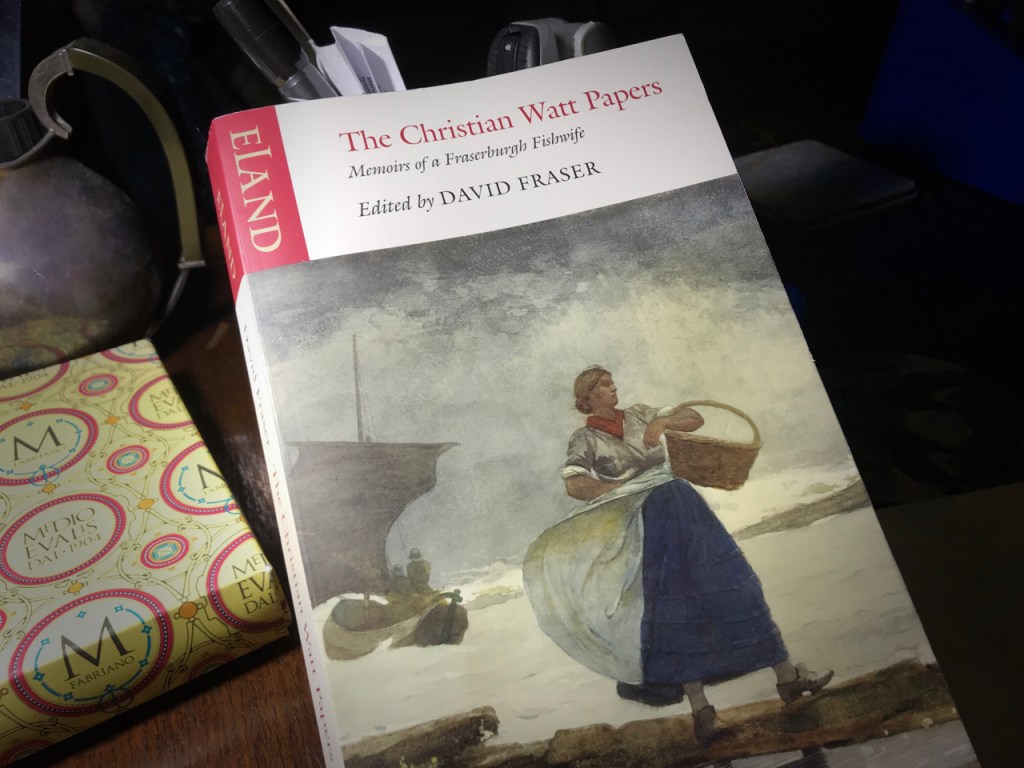
The Christian Watt Papers

This book has left me filled with admiration for the fishwives of Fraserburgh.

Christian Watt is, for I hear her still, so proud and so strong, despite all kinds of hardship and loss. Four of her seven brothers die at sea leaving her parents in despair. It is not long until her mother dies, physically exhausted from years as a fishwife.

“… with their skirts kilted above the knees they waded into the sea summer and winter with their men on their backs to ensure the men would go to sea dry …”.

Yet despite the hardships Christian marries a fisherman herself, and it is as a fishwife, and mother of ten children, that life begins to overwhelm her. She faces more deaths by drowning, including that of a favourite son and then her husband, the impact leaving her struggling with poverty, the law, and her mental health. Eventually, strained beyond coping, she is certified and admitted to the asylum in Aberdeen on a permanent basis. There she begins to write. Calmer and cared for, she details the wars and events, lives and challenges that surround her, her children and their community as they move into the new century.

Christian dies in 1933, trusting implicitly in God.

This version of her papers – first published in 1988, and edited by General Sir David Fraser, a descendant of the Fraser family that knew her so well, and to which she was related – keeps her voice alive. Brave and kind, it speaks out consistently against subservience, poverty, prejudice, racism, snobbery and war. I loved it.

Copyright Georgie Knaggs & The Phraser 2023
Unknown's avatar

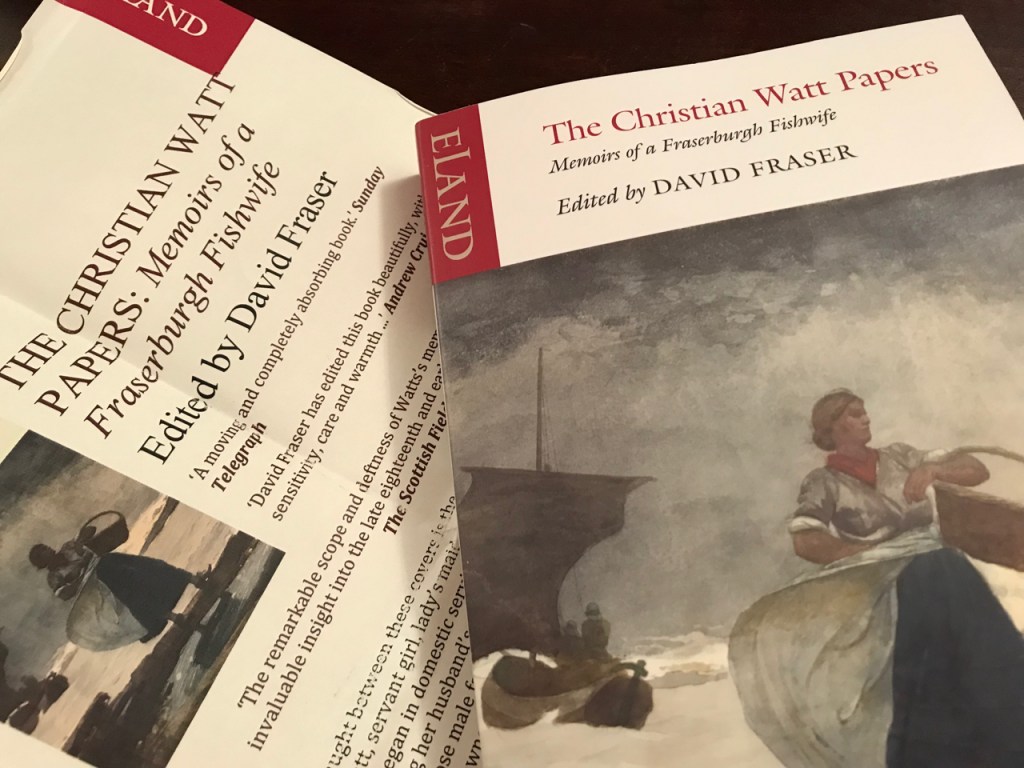
The Christian Watt Papers

“There was so much talk of war it made me feel ill.”

A hectic fortnight has meant that it’s taken me longer than it should have to read this book, but I’m now into the final third and just as fascinated as I was at the start.

From the beginning the voice of Christian Watt is as strong as the cover suggests. She has such a sense of who she is that her personality still reaches out loud and clear two centuries after she was born.

Like others in the fishing community where she was born her life is hard, but it becomes increasingly difficult when she starts to lose those she loves or depends on. When her husband is drowned she becomes utterly impoverished and exhausted, the effort of providing for their many children eventually destroying her mental health to such an extent that she is finally admitted to the asylum in Aberdeen on a permanent basis. It is there that she starts to write.

She writes about the different dialects still being spoken around Scotland, and of the pittance being paid by a “grateful nation” to a veteran of the Battle of Waterloo. She has no time for the pompous or pretentious, and is “furious at a society which forced bairns to work.” She wishes that better pay and working conditions could have been enshrined at the start of the Industrial Revolution, and she is scathing about the concentration camps of the Boer War.

Here is what she has to say about the arrival of the Great War.

“Never did I think I would live to see the day when the enemy would be coming out of the sky. They were flying in the air like birds and going down in the sea like fishes, and the world was running with blood.”

She loses family and friends at Gallipoli, Ypres and the Somme.

“No person wants to kill another. It is politicians who start wars and expect others to fight them.”

I am looking forward to reading what she has to say in the final hundred or so pages I have left.

Copyright Georgie Knaggs & The Phraser 2023
Unknown's avatar

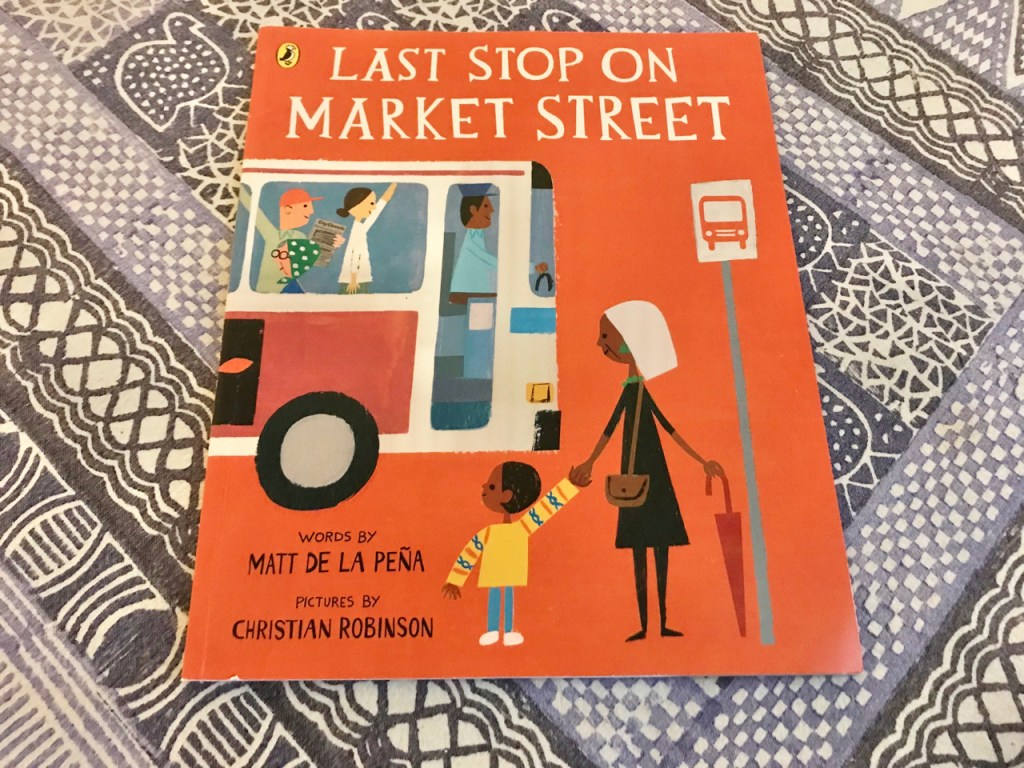
Last Stop on Market Street

Here is another picture book that I’ve enjoyed. I only discovered this one today when it was picked out of a pile by a young girl I was reading with.

The story is simple. It is about a child’s route home with his grandmother after school. He wishes he could drive away in a car like his friend Colby, but his grandmother insists the bus will be fine. And it is. On the journey he meets the people from his community, and sees how his grandmother interacts with them, gently showing him how much he can learn and enjoy from their company. Their bus journey ends at the last stop on Market Street, which is in a raggedy neighbourhood. The boy is a little unnerved as they make they way through it to the soup kitchen, where his grandmother is soon serving the others.

It is a quiet book with strong themes that don’t dominate the story too much. Instead they are woven cleverly into the words or picked up by the pictures in such a way that they let the journey take us to the end of the book. I thought it was such a powerful combination. The text is by Matt de la Peña, and the pictures by Christian Robinson.

When the young girl and I reached the end of the book I flipped to the back cover and saw that it had a small picture at the top with the words “Gold Medal Selection – Dolly Parton’s Imagination Library”. I was so excited to read this, as I’d heard often about the free books delivered to children from Dolly Parton, and here in my hands, was one of them.

These are some of the words on that back cover, describing her hopes for the books:

“… Dolly understands that reading is the key to a strong education, and that a child’s imagination is the centre of his/her dreams and creativity. By combining the two, this programme inspires children to dream more, learn more, care more, and be more …”

I thought this book did all of that.

Copyright Georgie Knaggs & The Phraser 2023