Unknown's avatar

Postcard from the romantic garden, Sanderumgaard

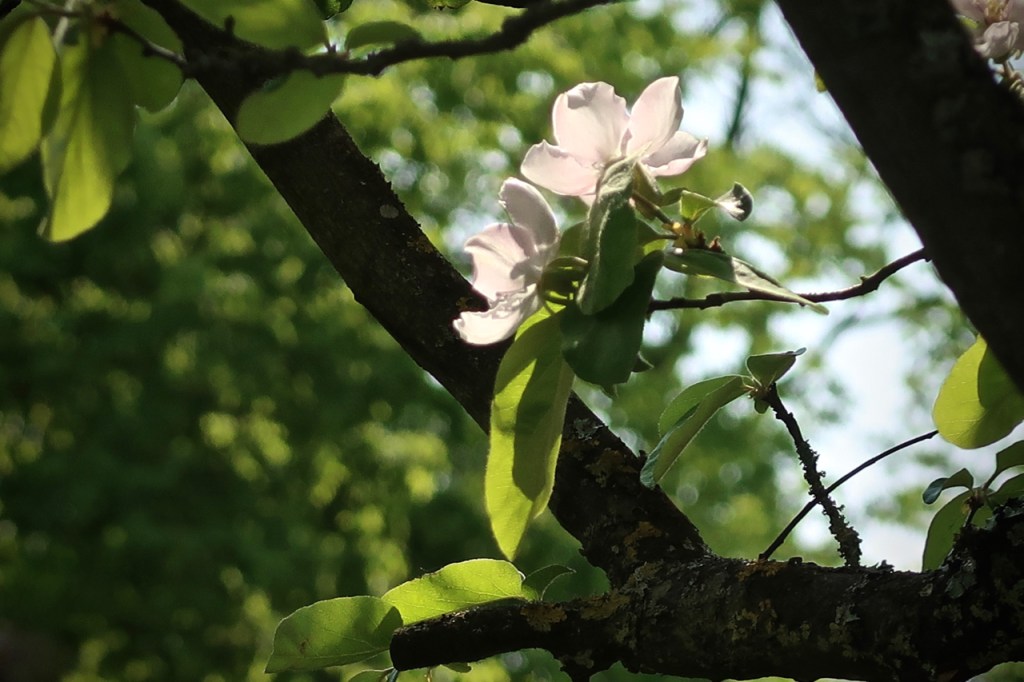
Today we had our picnic under an apple tree in the romantic garden at Sanderumgaard, Odense, Denmark. The sun was soft, and the blossom full. It was the perfect spot to pause, and although the roses and peonies were still to bloom, it was easy to imagine their colour and fragrance taking over the top lawns around the small orchard where we sat.

We’d arrived a few hours earlier and wandered through the garden, beginning amongst the apple trees, and then walking through the long arched tunnel of young limes, to the acres of beech trees and water features beyond. It was peaceful and cool, with occasional glimpses back to the imposing manor house.

The garden, restored after well over a century and a half of neglect, are managed mostly by volunteers, and the owners Erik and Susanne Vind, who have brought the garden back to life following the plans and pictures of its creation under the care of owner Johan Bülow, in the late 18th century.

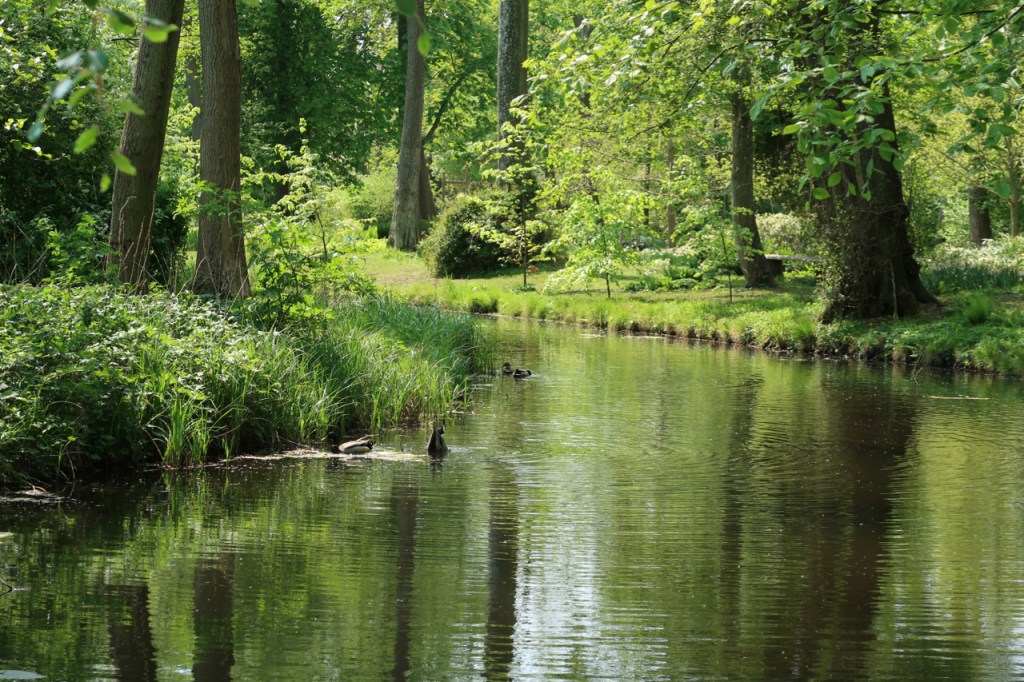
I loved the feel of the garden – the water, the ducks, the enormous, gnarled old stump, the swing in the beech trees, the bridges, the field of peonies, and the promise of the roses encircling a statue of Hermes on his rock. Everything felt right, and all protected by the long low arms of old red roofed barns.

It was such a pleasure to be there, and easy to understand why the famous Danish artist, Christoffer Wilhelm Eckersberg, had wanted to paint this place.
Copyright Georgie Knaggs & The Phraser 2023
Unknown's avatar

Postcard from the Sea War Museum, Jutland

“War is a tragedy and should not be glorified, but the history must be told and the victims remembered”

It was evening by the time we reached Thyborøn, a fishing town in Jutland. A cold sea mist hung over the place, with the wind dropping temperatures to an icy bite – a surprising change after the hot sun we’d enjoyed that morning.

After fish and chips by the harbour we walked around the war memorial park which was laid out along the coast off which the Battle of Jutland took place in 1916. In that battle, involving approximately 100,000 men on 250 warships, 25 ships were sunk, and 8,645 sailors perished.

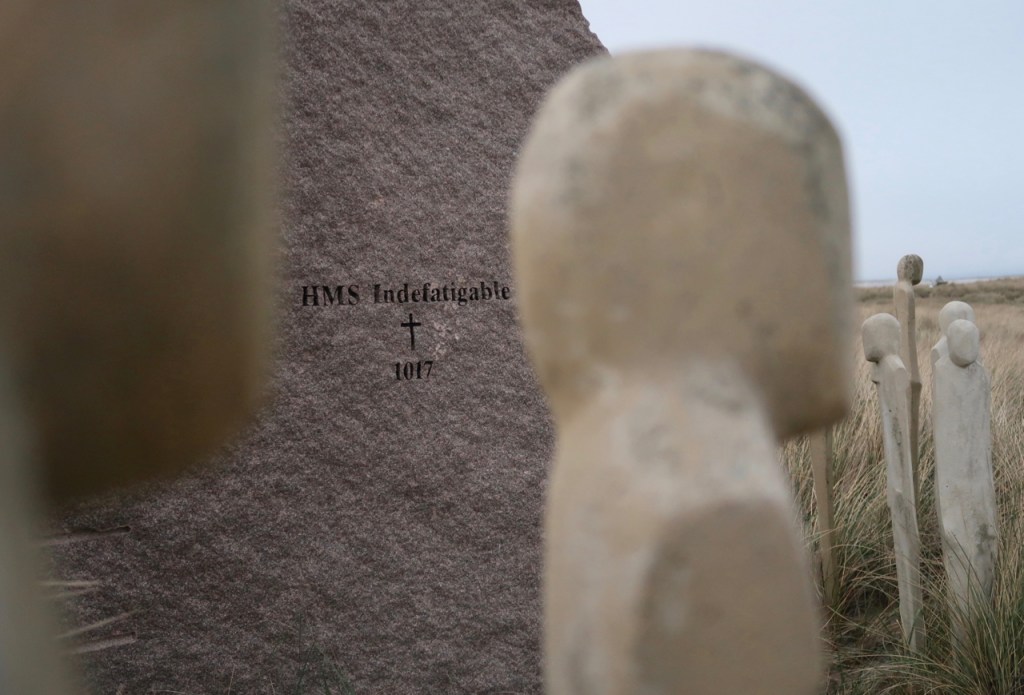
The park has no boundaries, and no list of names. Rather it takes the shore as its ocean, and granite for its ships. The most striking aspect of the park are these large chunks of granite set in the dune grass, several metres apart from each other, and all at various angles. These represent the final position and view of each ship’s stern, before it sank beneath the waves.

Carved into each slab of granite is the name of a ship lost in the battle. Some are German, some British, and beneath each name a number records the dead. Around these sternstones, pale, slender figures stand vigil, their ghosts loyal to the ships on which they served.

The park is such a quiet work of art. An understated memorial on a neutral shore, that continues to bear witness to the horror of what took place as the German and British fleets fought each other for control of the ocean. Both sides, fighting almost blind in the weather and the dark, lost thousands of men in a matter of hours from the afternoon of 31 May, into the early hours of 1 June 1916.

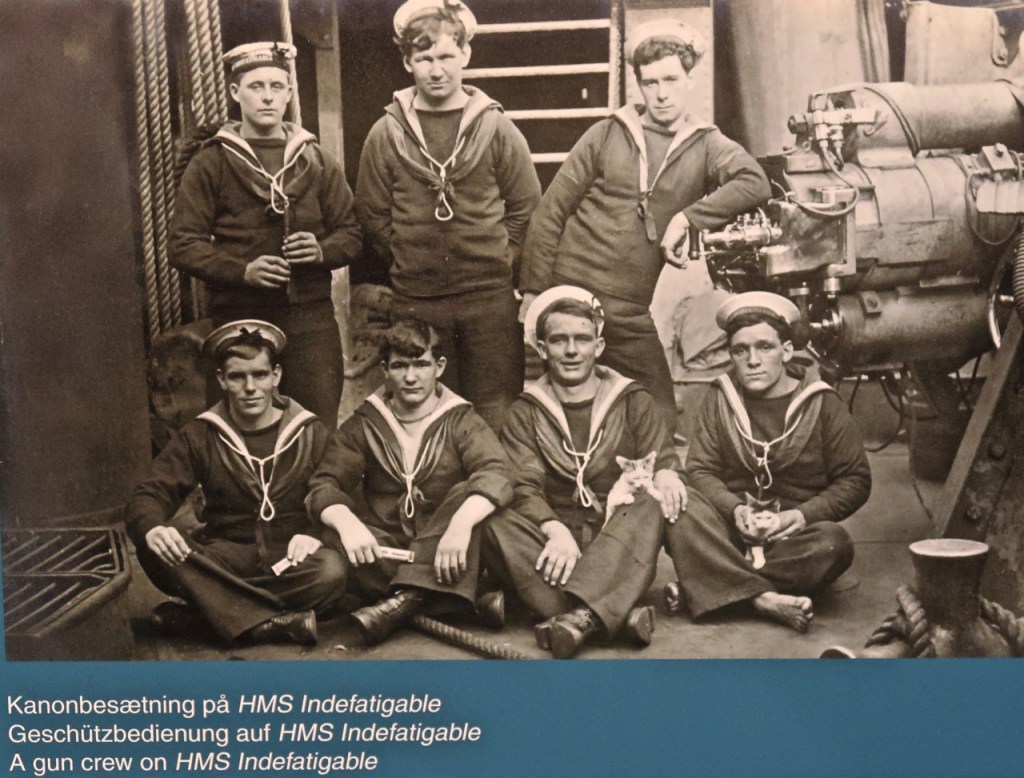
It is said, that the guns of the battle could be heard in Thyboron. On the quiet misty evening we were there, all we could hear were waves thumping on to the shore. As I thought of my great-uncle, who died serving as a mid-shipman on HMS Defence, aged just fifteen, I saw a mother and her young lad walking through the park. While I watched the boy paused briefly to shake a few of the ghosts. The next day, in one of the excellent displays, I saw the photograph above, and imagined that one of the young men in the photograph might have done exactly the same.

If you are interested in the Battle of Jutland, or naval warfare, I hope you manage to get to visit the Sea War Museum. It is full of fascinating detail about the battle, and those who took part, as well as the ships, submarines, aircraft and mines, and it is careful always to show both sides.

Copyright Georgie Knaggs & The Phraser 2023
Unknown's avatar

Postcard from Jelling, Denmark

Today, another beautiful blue day of just-right sunshine, we walked through the tall, fresh green of a beech forest near Copenhagen, and then drove out of the city to visit the Unesco World Heritage site at Jelling, in Jutland.

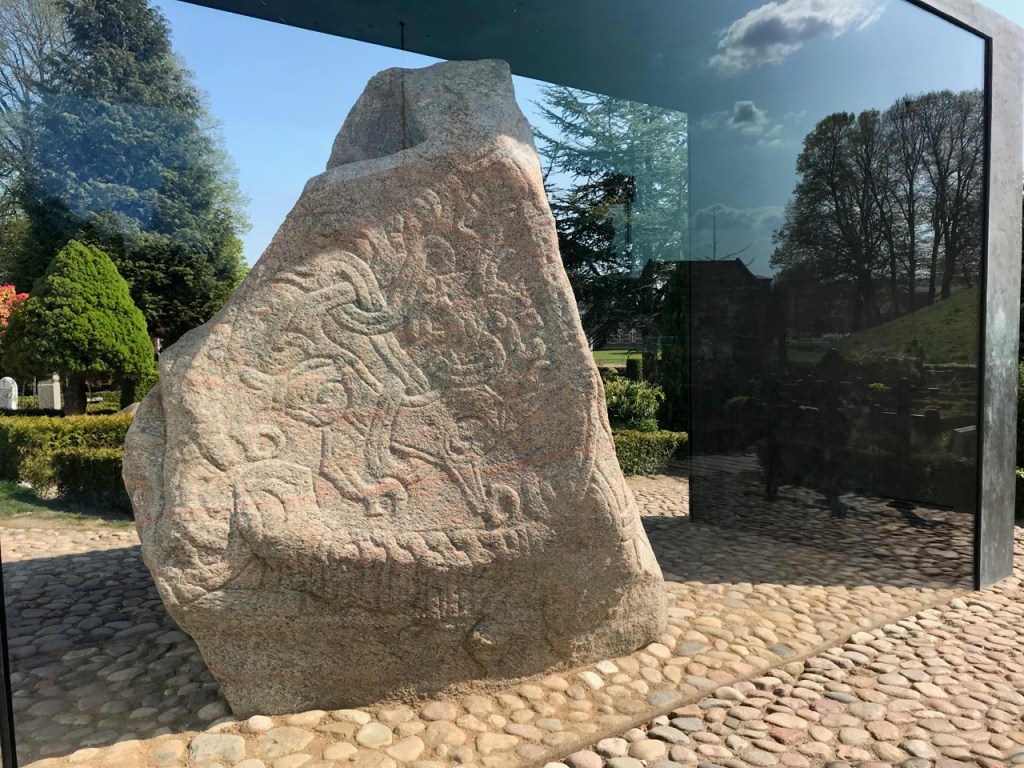
There are burial mounds, archaeological finds, an old church, and two rune stones at the site. The photograph above is of Harald’s stone, carved in around 965, and described by some as the ‘birth certificate of Denmark’ . The other stone at the site, an older, smaller stone, is attributed to Gorm the Old, Harald’s father.

Harald Bluetooth, King of all Denmark (possibly with a rotten tooth, hence his name), ruled from around 958 to 986 and led Denmark’s transition to christianity. The stone photographed commemorates that change, as well his other political achievements, and his parents.

We ate our picnic and wandered happily around the mounds, and stones, and the immaculate graveyard, full of flowers and blossom. We also visited the old church, near the centre of the site. The building, both inside and out, is so clean and simple, with just a few touches of blue to bring the colour of the sky inside the high white walls. Definitely worth looking inside if you are lucky enough to get to Jelling.

It was only tonight, as I’m writing this, that I’ve realised that the Bluetooth symbol on the mobile I’m using is made up of the Nordic initials of Harald Bluetooth. Strange to think that he, and his centuries old stone in Jelling, are still, in a way speaking to us, as we connect with each other today.

Copyright Georgie Knaggs & The Phraser 2023