Unknown's avatar

Symbol of London – the Underground roundel

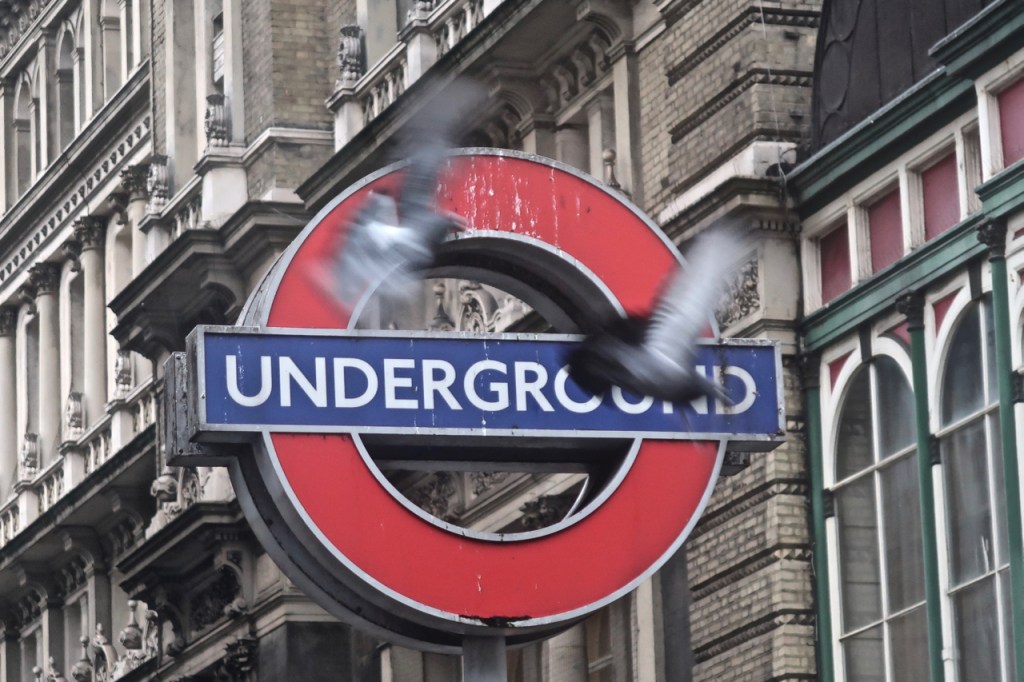
These ’roundels’ are such a part of London. Their colours make them easy to spot, and the simple lettering means that they can be read even through rain, and often from quite a distance.

This one is outside Charing Cross Station, and was photographed from the top of a bus. The pigeons flew off just as the camera clicked.

Apparently there is no one person’s name on the clear branding of the Underground signs, but it seems that the creative vision of two men in particular resulted in the symbol rooting its way through the city.

The man who designed the lettering on the roundel was Edward Johnston CBE (1872 – 1944). He was already well-known as a calligrapher when Frank Pick (1878 – 1941), the Chief Executive of London Transport, asked him to design the lettering for the capital’s transport system. The typeface – Johnston sans serif – was ready by 1916. The style, which must have looked different to most typefaces of its time, is now over a hundred years old and still doing well. It is clear and easy to read, especially when surrounded in the bold eye-catcher colours of the roundel. The design and lettering of the signs have been tweaked over the years, but they are still like beacons, whether you’re on foot or looking at a map, there they are, flagging up the transport options, and belonging always to London.

Edward Johnston loved good lettering for its ‘readableness, beauty and character’, and Frank Pick loved design for the harmony it could bring. At Frank Pick’s old school, St Peter’s in York, there is a memorial to him which reads:

“In tribute to Frank Pick 1878 – 1941 a scholar of this school. He served his fellow-men, made transport an art and sought beauty and good design in all things.”

Copyright Georgie Knaggs & The Phraser 2023
Unknown's avatar

On a bus moving slowly through a busy London

“Kids believe in Santa; adults believe in childhood.” Cate Kennedy, Dark Roots

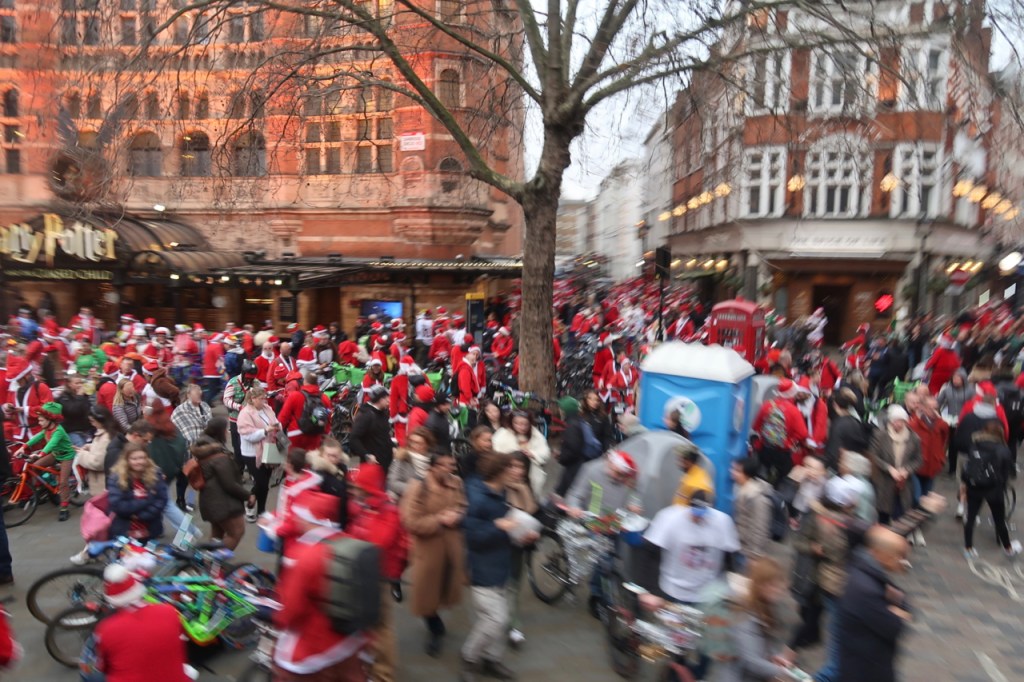
I knew London would be busy, but I did not expect it to be as busy as shown to me by the 139 bus, on diversion around Trafalgar Square to Oxford Street. And I did not expect to see so many Santas.

Halfway through the journey, I was busy wondering if the bus would ever be able to make its way through the stream of shoppers on a pedestrian crossing, when I saw the junction to our left crowded in red. I looked again. They were Santas. As I reached for my camera the bus began to inch, and then to accelerate forward. The result was the blurred picture above, confirmation at least of what I thought I’d seen. I’ve no idea where these Santas were headed, or where they’d been.

At last the bus made it to Oxford Street and I jumped off. By this time I was late, and the pavements were packed. They were also very relaxed. Too relaxed. They were having a good time, meandering like slow rivers, ferrying family groups and their packages to and fro. I dodged and huffed, trying to make my way around and through the window shoppers, and out-and-abouters, as best I could, praying hard that I wouldn’t get run over by a flourescent pedicab. Somehow I didn’t. Even more miraculously, I arrived where I had to … and just in time.

On my way back I decided to cram on to the Underground. That was a squished experience, but it did take about one fifth of the time it had taken the bus to reach the same point. The downside was there were no Christmas lights, and there was no sign of any Santas.

Copyright Georgie Knaggs & The Phraser 2023

Unknown's avatar

This was so worth the journey – The Holdovers

“We cannot sacrifice our integrity on the altar of their entitlement.” Mr Hunham in The Holdovers

It’s cold, it’s Christmas and five assorted students in a private boarding school are doomed to spend the holiday on campus. Mr Hunham is their reluctant babysitter, and Mary Lamb their heartbroken caterer.

The plot sounds predictable, and I thought the whole thing would be too gooey for my liking. I was wrong. I loved this. David Hemingson’s writing is delivered so completely and so physically by the three leads – Mr Hunham (Paul Giamatti), Angus Tully (Dominic Sessa) and Mary Lamb (Da’Vine Joy Randolph) – that I felt immersed from the start in the boys’ school. It’s all about personalities at the beginning and then gradually, thanks to the palette-subdued filming, the lack of mobile phones, and the occasional mention of the Vietnam War, it becomes clear that the story is set decades previously.

However, the question right at the heart of it has not changed over the decades – how will an old, and apparently unloved and boring teacher, be able to control the unhappy teenagers? The answer is revealed slowly, and made clearer by the removal of four of the group to leave only Angus, Mr Hunham and Mary. Over the rest of the film their stories emerge little by little, sometimes with a hint of ribbon and at others with a heart twanging sadness, but always the camera pulls out fast enough to keep the pace moving. Alexander Payne’s directing gives us a look at the loneliness of life, but he does not encourage us to wallow in pity for anyone, however sorry they feel for themselves … at least not until the goodbyes right at the end.

The film lasts a little under two hours. The score is gentle, and the settings simple and straightfoward. I found it an engrossing watch, my emotions flying this way and that, one minute laughing and the next minute sniffing. Thinking about it on my way home I wasn’t skipping down the street, but I did feel hopeful … and slightly stronger.

I found this article in Time magazine with more information about the film and the writer.

Copyright Georgie Knaggs & The Phraser 2023