Unknown's avatar

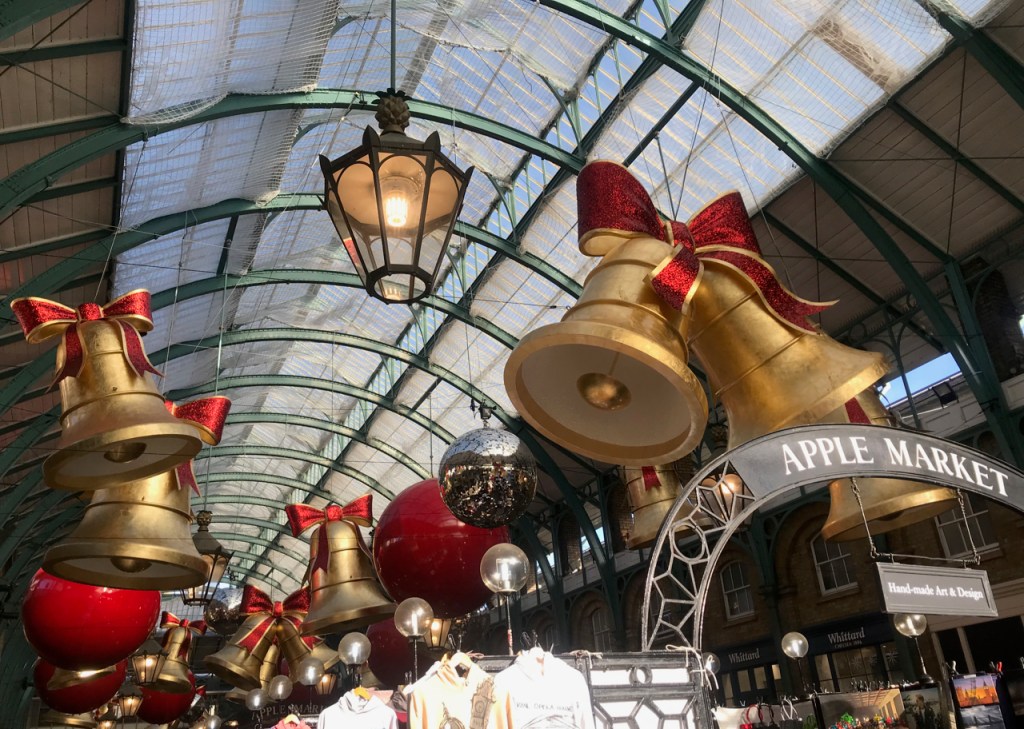
The bells were out in Covent Garden

London was busy with children today – half-term happy and full of sunshine. I met a few of them during the tube journeys I made.

The first family included three boys of primary school age, and two adults. They all remained calm during the few stops I was with them. Perhaps this was due to the middle child, aged around six, who seemed to be studying a copy of a medium-sized newspaper with real attention. Cool as a commuter he held the paper out wide in front of him, succeeding in drawing envious glances from the boy beside him. The family spoke only occasionally, and when they did it seemed to be in German.

On my next journey the second family to sit down opposite me were French. The three boys were around the same age as those in the first family, and were accompanied by two adults, one of whom I assumed was the grandmother. They all behaved immaculately, and were dressed immaculately – so immaculately I began to wish I’d made more of an effort. Then the third family arrived.

The two boys – one probably seven and the other a little younger – sat down beside me, while their mother stood, making anxious suggestions to them about sitting still. They did not listen. They knew they had the attention of the French boys on the seats opposite, and seemed to consider it a matter of national pride that they should demonstrate their best wrestling techniques and their worst language, while their mother wilted with exhausted embarrassment beside them. As my stop arrived the youngest was attempting acrobatics off the hand rail.

I left the train with a mental salute to all parents, but especially the lone parents out there, trying to manage young children through half-term. Definitely not one of the easier jobs going.

Copyright Georgie Knaggs & The Phraser 2023
Unknown's avatar

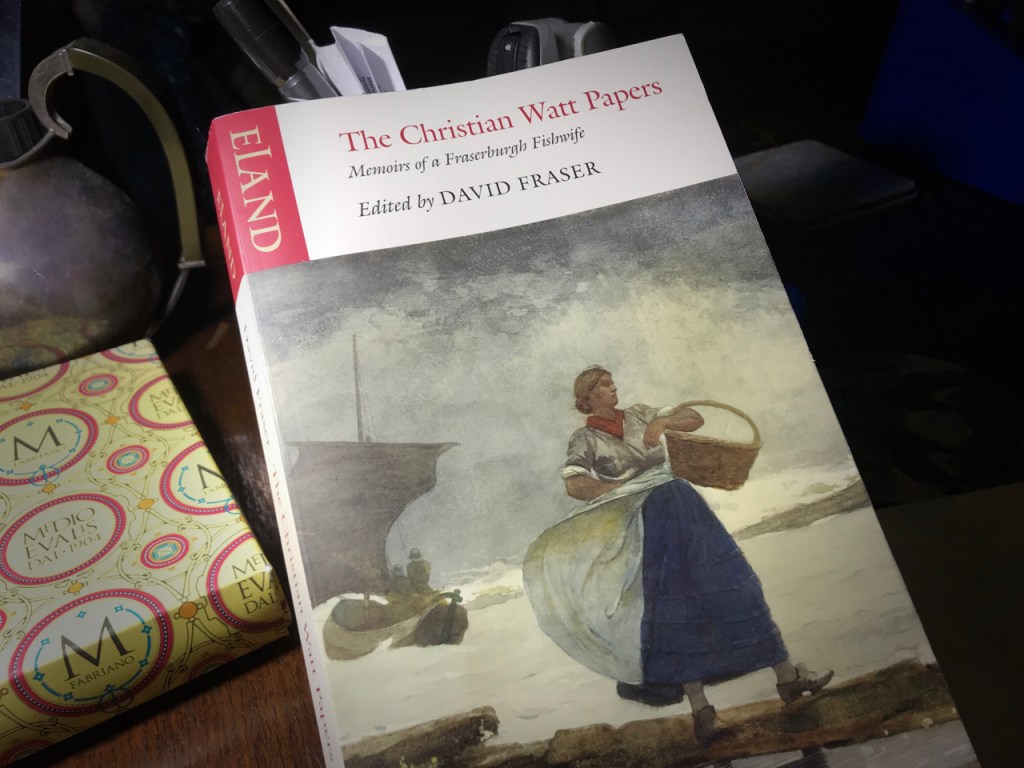
The Christian Watt Papers

This book has left me filled with admiration for the fishwives of Fraserburgh.

Christian Watt is, for I hear her still, so proud and so strong, despite all kinds of hardship and loss. Four of her seven brothers die at sea leaving her parents in despair. It is not long until her mother dies, physically exhausted from years as a fishwife.

“… with their skirts kilted above the knees they waded into the sea summer and winter with their men on their backs to ensure the men would go to sea dry …”.

Yet despite the hardships Christian marries a fisherman herself, and it is as a fishwife, and mother of ten children, that life begins to overwhelm her. She faces more deaths by drowning, including that of a favourite son and then her husband, the impact leaving her struggling with poverty, the law, and her mental health. Eventually, strained beyond coping, she is certified and admitted to the asylum in Aberdeen on a permanent basis. There she begins to write. Calmer and cared for, she details the wars and events, lives and challenges that surround her, her children and their community as they move into the new century.

Christian dies in 1933, trusting implicitly in God.

This version of her papers – first published in 1988, and edited by General Sir David Fraser, a descendant of the Fraser family that knew her so well, and to which she was related – keeps her voice alive. Brave and kind, it speaks out consistently against subservience, poverty, prejudice, racism, snobbery and war. I loved it.

Copyright Georgie Knaggs & The Phraser 2023

Unknown's avatar

An Imperial Crown Chalice by Ash & Plumb

Last week I went with friends to the Woodturning Connect Master’s Exhibition held in the Pewterers’ Hall in London. This exhibition – on the theme of the Coronation of King Charles III – was organised by the Worshipful Company of Turners.

I loved walking around the small exhibition, where each of the twenty or so pieces was so different from the other, and so skillful. Some were intricately patterned and coloured, some imaginative, some practical, and one, chosen by the V&A Museum, was a genius interlocking of four giant rings, titled Continuity Rings. It was beautiful – so complex, but so simple and pleasing, and being the size of small bicycle tyres, big enough to easily appreciate. I noticed that in the brochure they used the word torus rather than ring, describing the piece as ‘a sculpture of four interlocking segmented toruses made from 2,048 oak segments.’ The turner who produced the piece was Nathanael Griffiths, aged 20 from Chester.

A torus, in case you’re wondering, is (according to the Cambridge dictionary): ‘a shape that is a circular tube that is hollow inside’. It goes on to say :‘a popular shape for space stations is the doughnut shape also called a torus’.

Imperial Crown Chalice, shown in the photograph above, was another exhibit that I was drawn to. This was created by Barnaby Ash and Dru Plumb, the brochure describing it as a ‘playful and ancient reference to the form of the imperial crown but reinterpreted as a vessel … This vessel features many natural fissures that we have celebrated through stitchwork repair.’ I loved the deep colours in the wood, and longed to pick it up and touch its smoothness, everything about its simple oakiness and texture appealing to me.

But understandably, there was no touching of the exhibits, just the chance to admire these real treasures in wood, individual and ingenious in their interpretation of the theme. Sadly my postcard is not enough to do any of them justice.

Copyright Georgie Knaggs & The Phraser 2023