

“There was so much talk of war it made me feel ill.”
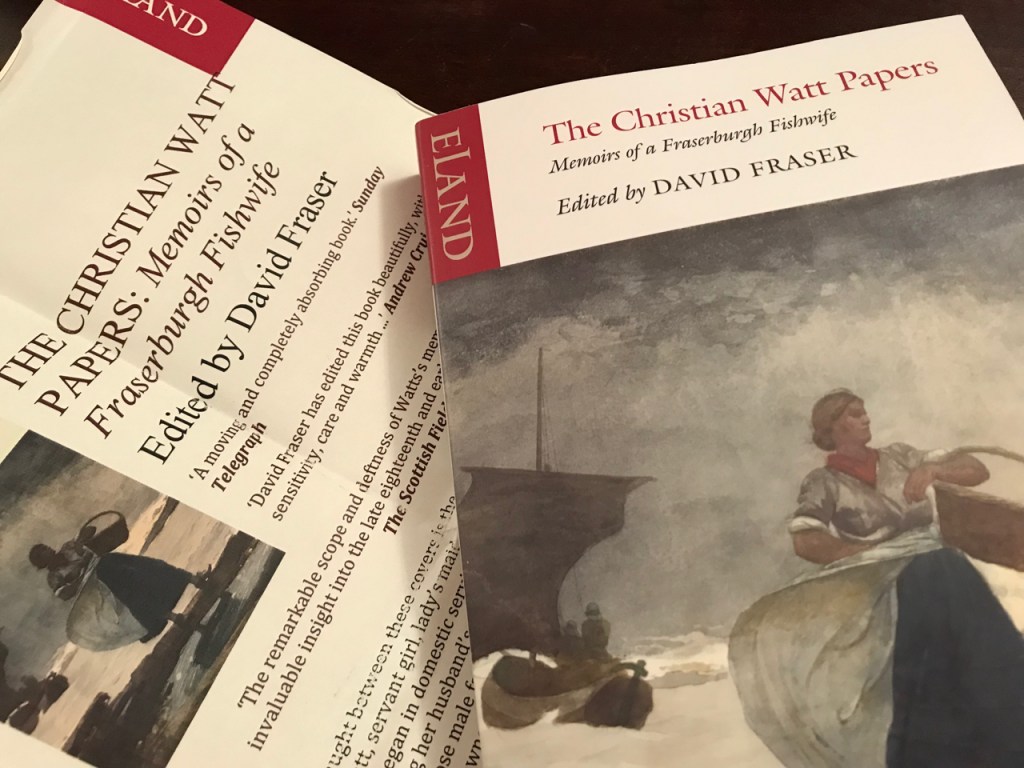
A hectic fortnight has meant that it’s taken me longer than it should have to read this book, but I’m now into the final third and just as fascinated as I was at the start.
From the beginning the voice of Christian Watt is as strong as the cover suggests. She has such a sense of who she is that her personality still reaches out loud and clear two centuries after she was born.
Like others in the fishing community where she was born her life is hard, but it becomes increasingly difficult when she starts to lose those she loves or depends on. When her husband is drowned she becomes utterly impoverished and exhausted, the effort of providing for their many children eventually destroying her mental health to such an extent that she is finally admitted to the asylum in Aberdeen on a permanent basis. It is there that she starts to write.
She writes about the different dialects still being spoken around Scotland, and of the pittance being paid by a “grateful nation” to a veteran of the Battle of Waterloo. She has no time for the pompous or pretentious, and is “furious at a society which forced bairns to work.” She wishes that better pay and working conditions could have been enshrined at the start of the Industrial Revolution, and she is scathing about the concentration camps of the Boer War.
Here is what she has to say about the arrival of the Great War.
“Never did I think I would live to see the day when the enemy would be coming out of the sky. They were flying in the air like birds and going down in the sea like fishes, and the world was running with blood.”
She loses family and friends at Gallipoli, Ypres and the Somme.
“No person wants to kill another. It is politicians who start wars and expect others to fight them.”
I am looking forward to reading what she has to say in the final hundred or so pages I have left.
Copyright Georgie Knaggs & The Phraser 2023
 The Phraser